
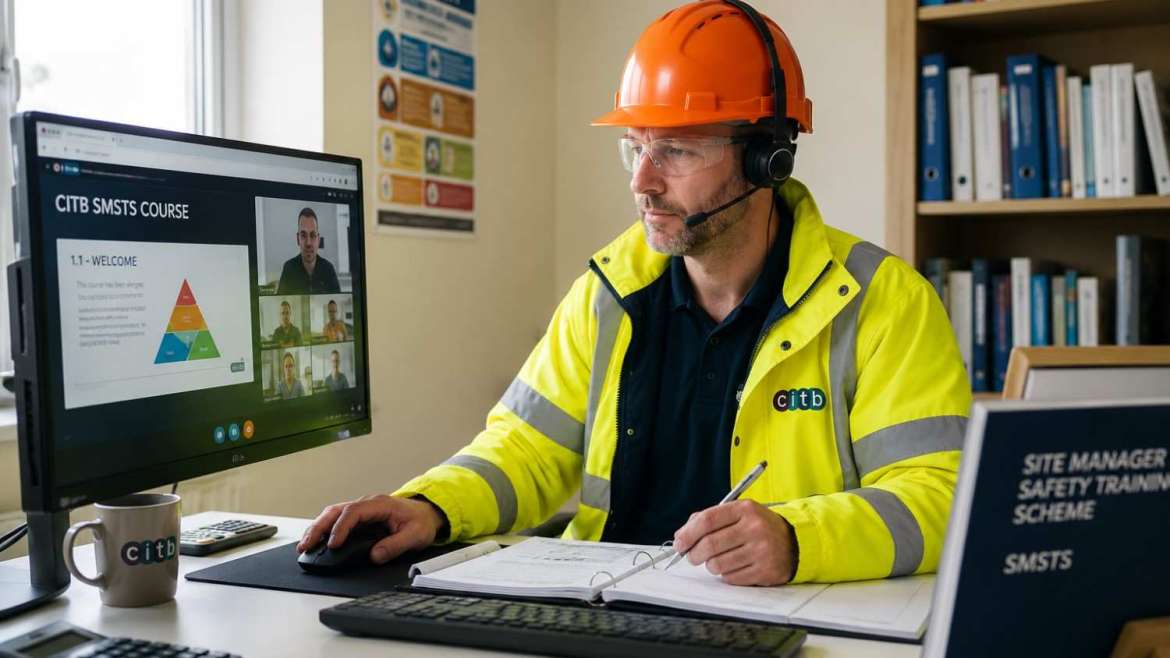
The Site Management Safety Training Scheme (SMSTS) is one of the most highly respected qualifications in the UK construction industry. Designed for site managers, project managers, and senior supervisors, it establishes that you possess the rigorous legal and practical knowledge required to keep a site safe, compliant, and efficient.
However, many professionals underestimate the difficulty of the course. When transitioned into an online environment, the intensive five-day syllabus requires not only an understanding of complex health and safety legislation but also absolute self-discipline, technical readiness, and sharp focus.
If you want to advance your career or keep your qualifications current, taking an SMSTS Course Online provides incredible flexibility. However, passing on your first attempt is crucial to avoid the cost and time of retaking the modules. This comprehensive guide breaks down exactly what the course entails, the breakdown of the final exam, and the best actionable strategies to guarantee a first-time pass.
What Is the SMSTS Course?
The SMSTS is an industry-recognized training program created by the Construction Industry Training Board (CITB). It is designed to provide a comprehensive understanding of health, safety, welfare, and environmental issues on construction sites. The course highlights a manager’s legal responsibilities and details how to implement practical health and safety measures on-site.
Traditionally taught in physical classrooms, the curriculum is now widely accessible via live, tutor-led remote classrooms, allowing professionals to complete their smsts training online without commuting. The qualification lasts for five years, after which managers must take a shorter smsts refresher course to keep their certification valid before the original certificate expires.
Who Needs the SMSTS?
The SMSTS is specifically tailored for individuals who hold, or are about to look after, management responsibilities on a construction site. This includes:
- Site Managers and Assistant Site Managers
- Project Managers
- Senior Supervisors and Site Agents
- Business Owners in the construction sector who actively oversee site operations.
Principal contractors on major projects often make this certification a mandatory prerequisite for their management staff to ensure everyone on site speaks the same language when it comes to risk mitigation and legal compliance.
What Does the SMSTS Cover? The Full Curriculum
The SMSTS framework spreads across five distinct modules. Knowing the weight of these topics allows you to allocate your study time effectively:
- Module 1: Legal and Management: Deep dive into the Health and Safety at Work Act 1974, the Management of Health and Safety at Work Regulations, and specific legal liabilities of a site manager.
- Module 2: Health and Welfare: Covers occupational health hazards on site, including asbestos, silica dust, noise, vibration, and mental health provisions.
- Module 3: General Safety: Focusing on day-to-day site management, site inductions, method statements, and clear communication frameworks.
- Module 4: High-Risk Activities: The most scrutinized area of the course. It involves working at height, confined spaces, demolitions, structural alterations, and overhead/underground utilities.
- Module 5: Environment: Waste management, pollution controls, and sustainable construction practices.
Understand the Reality of the Online SMSTS Format
Moving from a traditional classroom to a virtual one does not make the course any easier. The online format follows the exact same stringent CITB syllabus and assessment criteria as the in-person version.
The Virtual Classroom Environment
The course is typically delivered via video conferencing platforms like Zoom or Microsoft Teams over five consecutive days (or one day a week for five weeks). A CITB-qualified tutor leads live sessions, updates you on real-time regulations, and facilitates group discussions.
- Attendance is mandatory: Missing even a small portion of a live session can result in immediate disqualification from the course, forcing you to register and pay again from scratch.
- Camera compliance: You are generally required to keep your webcam on throughout the entire duration of the course to verify identity and engagement.
- Continuous tutor assessment: The final exam isn’t your only hurdle. Your instructor continuously evaluates your contributions during team exercises, case studies, and risk assessment tasks.
SMSTS Exam Structure & Pass Marks
To pass the test, you need to understand exactly how it is graded. The final assessment takes place online under strict invigilation conditions.
The Exam Breakdown
The exam lasts 35 minutes and consists of 25 questions split into two distinct parts:
| Section | Number of Questions | Question Type | Marks Available |
| Part A | 18 Questions | Multiple-choice / Multi-response | 1 Mark each |
| Part B | 7 Questions | Short written answers / Free text | 2 Marks each |
| Total | 25 Questions | — | 32 Marks |
The Critical Passing Rules
Passing the SMSTS requires meeting two strict, non-negotiable benchmarks:
- The 81% Threshold: You must achieve a minimum score of 26 out of 32 total marks.
- Safety-Critical Questions: The exam includes approximately five “safety-critical” questions. These cover high-stakes scenarios where a wrong decision could lead to a severe site injury or fatality (e.g., working at height, excavations, scaffolding). You must answer 100% of these safety-critical questions correctly. If you score a perfect 92% overall but get just one safety-critical question wrong, you automatically fail the entire exam.
What happens if you fail? If your overall score falls between 72% and 80% (23 to 25 marks) and you passed the safety-critical elements, you may be offered a same-day or quick turnaround re-sit. Scoring below 72% means you must retake the entire 5-day course at your own expense.
Strategies for Success Before the Course Starts
First-time success begins well before your first morning logging into the virtual portal.
Complete Prerequisite Reading
Your training provider will grant you access to digital course materials or mail you the physical books primarily the CITB GE700: Construction Site Safety publication. Do not leave these shrink-wrapped until day one. Spend a few hours browsing the index, reading through the CDM (Construction, Design, and Management) regulations, and familiarizing yourself with the layout of the text.
Set Up an Optimized Remote Workspace
An online learning format requires a dedicated, quiet space where you won’t be interrupted by family, housemates, or phone calls.
- Hardware: Ensure your computer camera, microphone, and speakers work perfectly.
- Internet connection: Use a wired internet connection if possible, or sit close to your router. A dropping connection can cause you to miss crucial lecture points or log out of mandatory attendance trackers.
- Dual screens (Optional but highly recommended): Having one screen for the live video stream and a second monitor to browse digital PDF manuals, take notes, or look up regulations makes the experience significantly easier.
Passing the SMSTS exam on your first try is not about luck; it is about respecting the comprehensive CITB syllabus and planning your approach. By setting up a distraction-free learning environment, actively participating in team case studies, and mastering the strict time limit between the open-book and closed-book segments, you can approach your assessment day with complete confidence.
Securing this certification protects your financial investment, keeps your team legally compliant, and demonstrates your commitment to safety leadership. If your current certification is nearing its 5-year expiration mark, remember that you must step proactively into a training window before it lapses completely to remain qualified.
The SMSTS Exam: What to Expect
The SMSTS assessment takes place on the afternoon of day five and consists of two parts:
Multiple Choice Questions
A set of multiple choice questions covering the full breadth of the course content. These test your recall of legislation, regulations, definitions, and procedures. Read each question carefully, as the options are often very similar.
Written Questions
Scenario-based written questions where you will be presented with a construction situation and asked to identify hazards, explain the relevant legislation, describe control measures, and set out a manager’s responsibilities. This section tests your ability to apply your knowledge in a practical environment, not just recall it.
The pass mark is 81% (26 out of 32 total marks). Crucially, the exam also features approximately 5 safety-critical questions covering life-threatening risks like working at height or excavations; you must answer 100% of these safety-critical questions correctly to pass. Delegates who achieve at least 72% but miss the top benchmark on their first attempt may be eligible for a quick re-sit.
Conclusion
Managing complex construction health and safety legislation requires total precision—and so does keeping your corporate accounts, CIS compliance, and tax structures in order. While you focus on maintaining a safe, productive site and securing your certifications, let Quiz Training Ltd take the administrative weight off your shoulders.
We provide specialist accounting and financial planning support tailored for construction companies, project managers, and independent contractors. Don’t risk processing penalties or missing critical tax planning windows.Book a Consultation with Quiz Training Ltd Today.
Frequently Asked Questions
No. Once your five-year SMSTS certificate reaches its expiration date, it becomes completely invalid. You will not be eligible to take the shorter smsts refresher course and must retake the full 5-day SMSTS Course Online or in-person to get certified again.
The exam features five safety-critical questions. Even if you secure a very high score across the remaining questions, failing just one safety-critical question results in an automatic fail for the entire paper. Depending on your overall percentage, you may qualify for a quick re-sit, or you might need to register for the entire course again.
The qualification is officially valid for five years from the date of issue. However, the CITB recommends booking your refresher framework well in advance of that date to ensure there is no gap in your active qualifications on-site.
Most approved training providers include access to the digital PDF versions of the CITB GE700 publication or mail the physical books to you as part of your registration fee. It is highly recommended to check with your provider before the course begins so you have these materials ready for the open-book segment.
No, a mobile phone is not sufficient. Training providers require a laptop or desktop computer with a stable internet connection, a functioning microphone, and a high-definition webcam that must stay switched on for mandatory attendance tracking and live identity invigilation.