
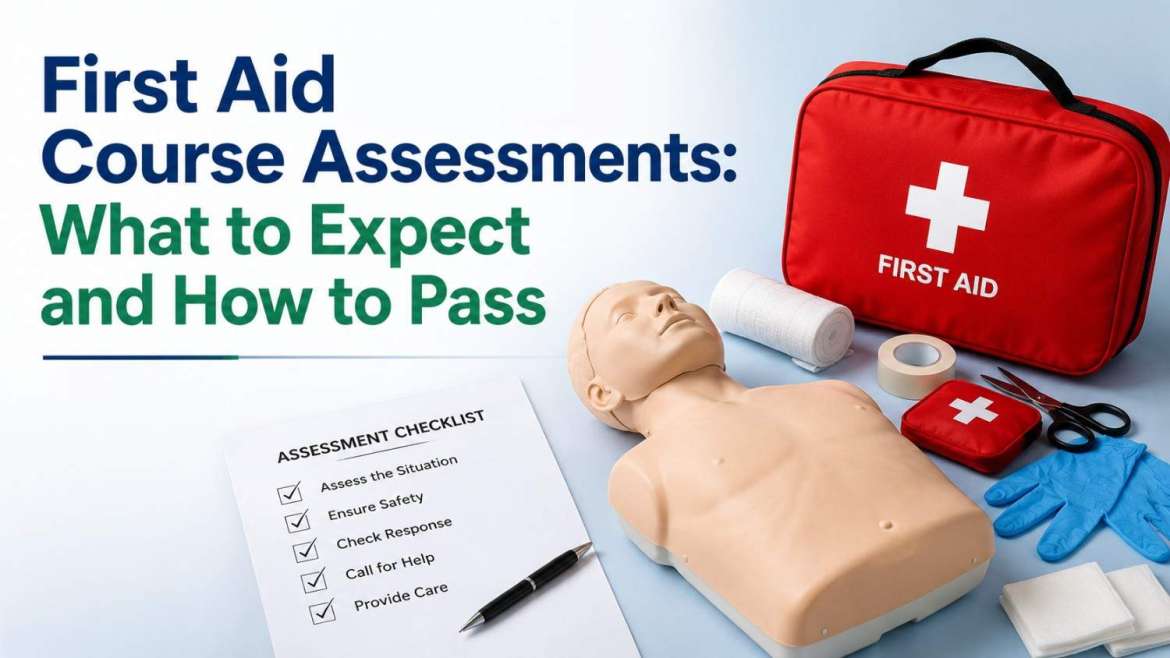
Taking a first aid training course can feel daunting, especially once you know an assessment is waiting at the end. It’s natural to worry about being watched by others, freezing mid-demonstration, or forgetting a step during a practical exercise. But here’s the reassuring truth: these assessments aren’t designed to trip you up. Their real purpose is to build genuine confidence, so you can act calmly and correctly if a real emergency ever happens.
Good first aid training works with you, not against you trainers who want you to succeed, and most courses give you plenty of chances to practise before anything is formally assessed. If you show up, stay engaged, listen closely to your instructor, and actually practise each skill as you go rather than just watching, passing becomes very achievable.
Understanding the Different First Aid Courses
Before looking at the assessment itself, it helps to know which course you are taking, since this affects what is tested.
- Emergency First Aid at Work (EFAW): This is a one-day emergency first aid training option, usually around six hours of training. It is a Level 2 or Level 3 qualification depending on the awarding body, and this emergency first aid at work course suits lower-risk workplaces such as offices, shops, and hospitality venues. It covers core emergency skills like CPR, choking, shock, and managing an unresponsive casualty.
- First Aid at Work (FAW): This is a more detailed course, typically run over three days. It is aimed at higher-risk workplaces such as construction sites, warehouses, and manufacturing environments. It builds on everything in EFAW and adds further topics, including how to manage a wider range of injuries and illnesses. If you work in high-risk sectors, you might eventually progress to an advanced first aid course or specialized advanced first aid training to handle complex medical emergencies.
Both qualifications are usually valid for three years, after which you need to complete a first aid at work requalification course. Providers also highly recommend a short first aid refresher course such as a yearly first aid at work refresher between full requalification cycles so your skills stay sharp.
How Are You Assessed?
Regardless of whether you book a standard class or find localized first aid training in London, UK workplace first aid qualifications almost always combine two types of assessment: practical and written (or oral).
1. Practical Assessment
This is the part most people feel nervous about, but it is usually more straightforward than expected. During practical assessment, you demonstrate first aid skills as you would in a real emergency. This often includes:
- Performing CPR on a training manikin, including chest compressions and rescue breaths
- Placing a casualty in the recovery position
- Managing choking
- Treating bleeding, including applying pressure and dressings
- Responding to a casualty who is unresponsive or not breathing normally
Trainers usually watch you throughout the course, not only during a single final exercise. This is called continuous assessment. It means your trainer builds a picture of your competence over the whole course, so a single small mistake in one exercise is unlikely to fail you, as long as you generally show the right knowledge and technique.
2. Written or Oral Assessment
Alongside the practical side, most courses include a written test, often multiple-choice, or oral questioning where the trainer asks you questions directly. This checks your theoretical understanding, such as:
- The role and responsibilities of a first aider
- How to assess an incident safely
- Recognising signs and symptoms of common injuries and illnesses
- When and how to call for emergency help
- Basic legal and reporting duties, such as keeping an accident record
Some providers use short multiple-choice papers spread across the course rather than one long test at the end. Others use a workbook or portfolio that the trainer completes with you, recording each skill and topic as you demonstrate it.
What Does a Typical Assessment Day Involve?
While formats vary between training providers, a general pattern is common across most EFAW and FAW courses:
- Group teaching and demonstration: The trainer explains a topic and demonstrates the correct technique.
- Practice in pairs or small groups: You then practise the same skill yourself, often on a manikin, with the trainer giving feedback.
- Short knowledge checks: These might be quick questions, a short quiz, or class discussion to check understanding before moving on.
- Final practical scenario: Near the end of the course, you are usually asked to respond to a mock emergency scenario from start to finish, showing that you can put the separate skills together under a bit of time pressure.
- Final written or multiple-choice paper: This confirms your theoretical knowledge across the whole course.
You must pass both the practical and the knowledge elements to receive your certificate. If you took a blended course, meaning part of the theory was completed online beforehand, the classroom day will usually also test that online content, so it is worth reviewing it again before you attend.
Common Topics You Should Know Well
To prepare for the written or oral part of your assessment, make sure you are confident with these core areas:
- The primary survey: Also known as DR ABC or DRSABC (checking for Danger, Response, Airway, Breathing, and Circulation).
- CPR ratios and technique: Know the correct compression-to-breath ratio and hand placement.
- Recovery position: Understand when and how to use it, and why it matters for an unresponsive but breathing casualty.
- Choking: The back blows and abdominal thrusts sequence for adults.
- Shock: How to recognise it and the correct first aid response.
- Bleeding control: Applying direct pressure, using dressings, and recognising when bleeding is severe.
- Burns: Cooling techniques and when burns need emergency medical attention.
- Calling for help: Knowing what information to give the emergency services and when to use an AED (automated external defibrillator).
If you are on the full FAW course rather than EFAW, you will also need to know more advanced topics such as suspected fractures, spinal injuries, heart attacks, strokes, and anaphylaxis.
Tips to Help You Pass
- Get hands-on during practice sessions: Do not just watch. Ask to repeat a technique if you are unsure, since the practical skills are usually easier to remember once your body has done them, not just your mind.
- Say the steps out loud while you practise: Talking through DRSABC or the CPR sequence as you do it helps it stick, and it also shows your trainer that you understand the reasoning behind each action.
- Ask questions during the course: Trainers expect questions and generally want you to leave feeling confident, not just certified.
- Review your course book or workbook the night before: A quick refresh of the key steps reduces last-minute nerves.
- Treat scenario exercises like the real thing: Practising as though it is a genuine emergency, rather than rushing through it, helps you build the habits you will actually need one day.
- Do not panic over small slips: Continuous assessment means trainers are looking at your overall competence and confidence, not perfection in every single moment.
- Complete any pre-course online learning properly: If you are on a blended course, it is often assessed again in the classroom, so skipping it can catch you out later.
What Happens If You Do Not Pass?
It is uncommon to fail outright, since most people who attend fully and engage with the practice sessions meet the required standard. If a trainer identifies a gap in your practical skills or knowledge, they will usually give you the chance to practise more and reassess that specific area before the course ends. In rare cases where more support is needed, you may be asked to attend a further session or retake part of the course.
Final Thoughts
First aid assessments are designed to ensure you have the practical skills and knowledge needed to respond confidently during real-life emergencies. They focus on preparing you to provide safe, effective assistance rather than catching you out with difficult questions. By actively participating throughout the training, practising essential first aid techniques, and reviewing the key concepts before your final assessment, you can build confidence and improve your chances of passing on your first attempt. Regular practice and a positive approach will help you feel fully prepared for the assessment. Whether you are completing the course for work, personal development, or legal compliance, achieving your certification demonstrates your ability to respond when it matters most.
If you’re ready to develop valuable life-saving skills and earn a recognised qualification, book your upcoming first aid course with Quiz Training today and take the next step towards becoming a confident and capable first aider.
Frequently Asked Questions
Because instructors use continuous assessment throughout the course, a single minor mistake is rarely enough to fail you. The trainer will look at your overall performance, give you constructive feedback, and typically allow you to try the exercise again until you demonstrate the safe, correct technique.
While some theoretical frameworks like a portion of a blended course or a specific mental health first aid course can be completed online, regulatory workplace qualifications like EFAW and FAW require in-person, hands-on practical assessments for CPR and physical injury management to maintain compliance.
There is no official grace period. Once your qualification expires, you are technically no longer counted as a certified first aider in your workplace. To keep your status seamless, you should book your requalification training before your current three-year certificate lapses.
The one-day EFAW assessment focuses purely on life-saving emergency intervention skills (like CPR and choking). The comprehensive three-day FAW assessment tests those same emergency skills plus a much wider range of specific medical scenarios, minor injuries, and workplace illnesses.
Yes. Correct posture, physical depth of chest compressions, and proper rescue breath delivery must be physically demonstrated on a specialized training manikin. If you have physical limitations or injuries that make kneeling difficult, let your training provider know in advance so they can accommodate you.