The UK rail industry is one of the most safety-regulated and consistently in-demand sectors in the country. With billions of pounds committed to infrastructure upgrades, electrification projects, and network expansion through schemes like HS2, the demand for qualified railway workers has never been higher. But entering this sector is not as simple as showing up with a hard hat and steel-toe boots; it requires a specific set of accredited certifications before you are legally permitted to set foot on or near the track.
This guide explains exactly what railway training courses cover, breaks down the key qualifications you need at every stage of your career, and answers the most common questions from people looking to enter or advance within the UK rail industry.
At Quiz Training, based in Barking, East London, we offer a comprehensive suite of railway training courses that take you from complete beginner to fully Sentinel-registered professional.
What Are Railway Training Courses?
Railway training courses are structured, accredited programs that teach individuals how to work safely and competently on or near the UK’s rail infrastructure. Unlike most other industries, the rail sector operates under strict Network Rail and Office of Rail and Road (ORR) regulations, meaning that no one can legally access a railway worksite without holding the correct, up-to-date qualifications.
These courses cover a wide range of topics, including:
- Track safety rules and Network Rail’s Rule Book
- Personal protection from moving trains and live electrification systems
- Safe working methods and emergency procedures
- Physical and medical fitness standards for safety-critical roles
- Specialist skills such as track maintenance, overhead line awareness, and site safety management
All railway qualifications are tracked through the Sentinel scheme, Network Rail’s official card and digital record system. Your Sentinel Card acts as your professional passport for rail work, listing every qualification you hold and confirming your medical fitness to work. Without it, no site manager on any Network Rail project will allow you access.
Who Are Railway Training Courses For?
Railway training courses are for a broad range of people, not just those swinging a hammer on the tracks. Whether you are a complete newcomer to the industry, a construction professional looking to diversify, or an experienced operative seeking to step into a supervisory role, there is a railway qualification pathway for you.
New starters and career changers who want to enter the rail industry for the first time need foundational courses like PTS training, a Network Rail medical, and a drug & alcohol screening to get their Sentinel Card and access infrastructure sites.
Construction professionals and subcontractors who already work near railway environments, such as station refurbishments, depot maintenance, or lineside construction, need qualifications like the Industry Common Induction (ICI) or Basic Track Awareness (BTA) to work legally within the railway boundary.
Track maintenance operatives looking to build a specialist career in the Permanent Way (P-Way) need the full Track Induction course alongside their PTS to become productive, site-ready members of a maintenance team.
Experienced railway workers who want to move into leadership and management positions should pursue Controller of Site Safety (COSS) certification, one of the highest-value and most sought-after roles in the entire rail sector.
Plant operators, crane drivers, and specialist machinery operatives working on rail projects need safety-critical medicals in London to prove their physical and mental fitness for high-risk roles.
The Core Railway Training Courses Explained
Personal Track Safety (PTS) Training — The Essential Entry Qualification
PTS training is the single most important qualification in the railway industry. Without a valid PTS certificate, you cannot legally work on or near the line anywhere on the UK’s National Rail network. It is the foundation that every other railway qualification is built upon.
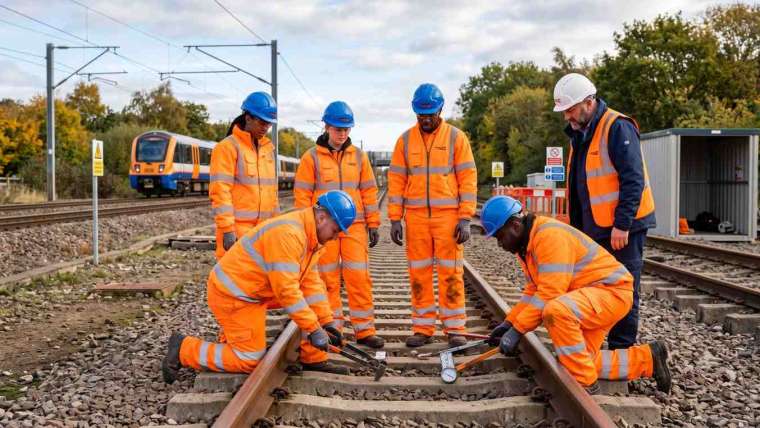
The PTS course covers the dangers present in the track environment, from approaching trains to live third rail and overhead line electrification systems. It teaches you the correct procedures for entering and exiting worksites, how to identify different track types, and what to do in an emergency.
At Quiz Training, our full PTS package is a two-day program that includes both classroom-based theory and practical on-track simulations. On completion, your results are uploaded directly to the Sentinel system, and you can apply for your Sentinel Card to begin working on Network Rail managed infrastructure.
Who needs PTS training? Anyone who will physically work on or near the railway line, track maintenance operatives, P-Way workers, rail welders, drainage engineers, and related infrastructure tradespeople.
PTS Recertification: The PTS certificate requires periodic renewal. Quiz Training offers a one-day PTS recertification course to keep your qualification current and your Sentinel Card active.
Railway Safety Training Course
A railway safety training course encompasses several qualifications that together build your understanding of how to work safely within the rail environment. These include:
Industry Common Induction (ICI) A mandatory one-hour qualification for anyone working on Network Rail sites that are off-track, such as station refurbishments, rail depots, or construction projects near the line. It covers essential health and safety induction requirements and is required before you can pass through the gate on most Network Rail projects.
Basic Track Awareness (BTA) A one-day course for individuals who need to access the railway environment but are not required to work directly on the track. This includes surveyors, project managers, station staff, and supervisors who may need to cross the line or work within the railway boundary. The BTA provides a thorough grounding in rule book protocols, electrification hazards, and correct crossing procedures.
Site Warden / Lookout Training A one-day course for operatives who will serve as the “eyes and ears” of a trackside team. Lookouts are responsible for monitoring approaching trains and providing unmistakable early warnings to the team. Site wardens ensure workers remain within the designated safe zone. Both roles are critical to the safety of every person on site and are listed on the Sentinel Card.
Together, these qualifications form the practical foundation of your railway safety training course portfolio and are often required by principal contractors before any other work begins.
Track Induction Course Becoming a Track-Ready Professional
The track induction course is where theory meets real-world practice. While PTS teaches you how to stay safe on the track, the Track Induction course teaches you how to actually perform the work. It is the qualification that transforms a new starter into a productive, site-ready member of a Permanent Way (P-Way) maintenance team.
This intensive five-day program at Quiz Training covers the following:
- Track engineering principles and geometry
- Use of heavy manual tools and specialist rail equipment
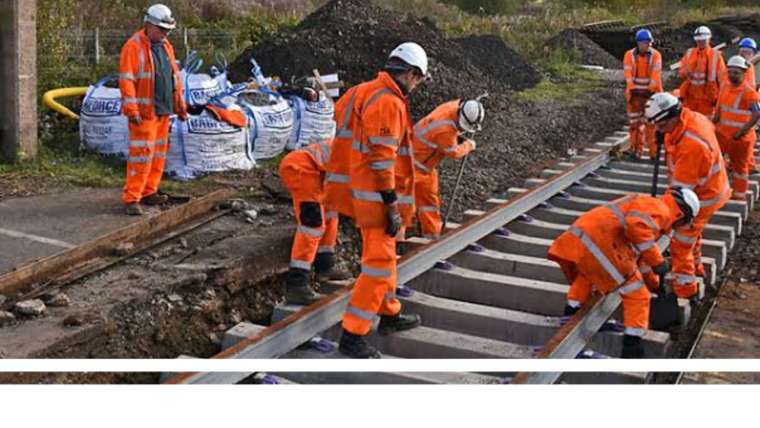
- Sleeper replacement, rail fastening, and ballast management
- Safe working methods and site communication
- Understanding your role within a P-Way team structure
The track induction is physically demanding and is designed to prepare you for the reality of working 12-hour shifts in all weather conditions. Employers in rail maintenance specifically look for operatives who have completed a full track induction because it demonstrates they are truly site-ready from day one.
Prerequisites: A valid First Aid certificate, Fire Marshal qualification, and Manual Handling certification are required before enrolling in the Track Induction course.
Who needs it? Anyone pursuing a career in railway track maintenance, P-Way laboring, or infrastructure engineering. It is the most direct route into hands-on rail work.
Safety Critical Medicals London
Before you can begin any railway training course that involves track access, you must pass a medical assessment. Quiz Training provides two levels of medical screening at our London center:
Network Rail Medical (£70 + VAT) This is the mandatory medical screening required for all individuals seeking a Sentinel Card. It assesses your physical and mental fitness to work in safety-critical railway environments and includes vision testing (including color blindness screening), hearing assessments, blood pressure checks, and a general health review. Results are uploaded directly to your Sentinel profile.
Safety Critical Medical (£70 + VAT) A broader, more intensive medical assessment is required for specific high-risk roles, including plant operators, crane drivers, scaffolders, and anyone working in confined spaces or at height on railway projects. It covers musculoskeletal fitness, respiratory health, and mental alertness, ensuring that those operating heavy machinery or working in extreme conditions are genuinely fit to do so safely.
Drug & Alcohol Screening (from £50 + VAT) The UK rail industry operates a strict zero-tolerance policy on drugs and alcohol. Every operative must pass a laboratory-standard screening before working on any Network Rail site. Quiz Training provides these screenings at our London CC center and also offers random and for-cause testing services for employers.
For anyone based in or around London, accessing safety-critical medicals in London through Quiz Training means same-day results, immediate upload to your Sentinel profile, and no unnecessary delays to your training schedule.
Controller of Site Safety (COSS)
The Controller of Site Safety (COSS) qualification is one of the most prestigious and high-value certifications in the entire railway industry. A COSS is responsible for establishing and maintaining a Safe System of work on any Network Rail worksite, meaning the lives of every operative on the team are directly in their hands.
Responsibilities of a COSS include verifying line blockages, coordinating with signalers, managing lookouts and site wardens, and responding to on-site emergencies with absolute precision. It is a deeply safety-critical role that requires not just technical knowledge but genuine leadership capability.
Quiz Training’s COSS The initial program is an eight-day course covering the rule book in depth, emergency scenario management, signaling systems, AC/DC electrical safety, and safety-critical communications. COSS recertification is available as a five-day refresher for those whose qualification is approaching its renewal date.
Who is COSS for? Experienced railway operatives who are ready to step into a supervisory or management role. Holding a COSS qualification significantly increases your daily rate and opens the door to management-level positions with Tier-1 contractors.
The Typical Railway Career Pathway
Understanding how these qualifications fit together helps you plan a clear and cost-effective route into the industry. Here is the typical progression for someone entering railway track maintenance from scratch:
Medical & Screening: Complete your Network Rail Medical, Drug & Alcohol Screening, and obtain a sponsor (employer or agency).
Safety Foundation: Complete the Industry Common Induction (ICI) and Personal Track Safety (PTS) training. Receive your Sentinel Card.
Site Skills: Complete the Track Induction course to become a productive P-Way operative.
Specialist Qualifications: Add Site Warden/Lookout, Small Tools Training, or OLEC 1 (Overhead Line Electrification) to your Sentinel profile.
Leadership: Progress to COSS certification and take on site safety management responsibilities with significantly higher earning potential.
Why Choose Quiz Training for Your Railway Qualifications?
Quiz Training is a trusted, accredited training provider based in Barking, East London—offering one of the most comprehensive portfolios of railway training courses available in the capital. Here is what sets us apart:
All qualifications under one roof. From your Network Rail medical and drug & alcohol screening to PTS, track induction, COSS, and OLEC 1—you can complete your entire railway training pathway with a single provider, saving time and reducing administration.
Expert industry trainers. Our instructors bring decades of frontline railway experience into the classroom, giving you insights that go beyond standard textbook content and genuinely prepare you for life on the track.
Fast Sentinel registration. We upload your results directly to the Sentinel system, meaning your qualifications are available to employers immediately upon completion.
Competitive pricing. From PTS training at £650 + VAT to same-day safety critical medicals at £70 + VAT, our pricing is transparent and designed to be accessible to individuals and employers alike.
Convenient London location. Our training center is based at Room 217, Roycraft House, 15 Linton Road, Barking, IG11 8HE, easily accessible from across East and Central London.
Get Started with Railway Training Today
Whether you are taking your very first steps into the rail industry or looking to add high-value qualifications to your Sentinel Card, Quiz Training has the courses, the expertise, and the location to help you achieve your goals.
Frequently Asked Questions
PTS (Personal Track Safety) training is the mandatory entry-level qualification for working on or near UK rail tracks. It teaches hazard awareness, safe systems of work, and track safety rules. Without a valid PTS certificate, you cannot legally access railway infrastructure.
A track induction course is a practical programme covering essential railway maintenance skills, including tool use, track components, and safe working practices. It is designed for those pursuing careers in track maintenance or P-Way roles and requires basic safety certifications beforehand.
A safety critical medical assesses your physical and mental fitness for high-risk roles. It includes checks on vision, hearing, cardiovascular health, and mobility. This assessment is required for safety-critical railway jobs and is offered by specialised training and medical providers.
No prior experience is needed to start railway training. Entry-level courses like PTS and inductions are designed for beginners. You will need medical clearance, drug and alcohol screening, and a sponsor to manage your certification before starting work.
A Network Rail Medical ensures you are fit for track access, covering basic health checks. A Safety Critical Medical is more detailed, required for high-risk roles like machinery operation, assessing deeper physical and occupational health to ensure safe job performance.